
 Produkty
Producenci
Produkty
Producenci
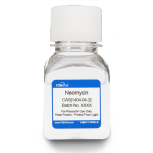
Neomycin solution (10 mg/mL Neomycin in 0.9% NaCl)

Opis
Produkt przeznaczony wyłącznie do badań. Nie nadaje się do spożycia. Więcej informacji na stronie producenta www.toku-e.com
Neomycin is a broad spectrum aminoglycoside antibiotic composed of a number of related neomycin compounds including neomycin A (neamine), neomycin B (framycetin), neomycin C, and a few minor compounds found in much lower quantities. Neomycin B is the most active component in neomycin followed by neomycin C and neomycin A. The quantities of these components in neomycin vary from lot-to-lot.
Solution contains 10 mg/mL neomycin sulfate in 0.9% NaCl.
CAS Number: 1405-10-3
Molecular Formula: C23H46N6O13
Molecular Weight: 614.64 g/mol
Mechanism of Action
Aminoglycosides target the 30S ribosomal subunit resulting in an inability to read mRNA ultimately producing a faulty or nonexistent protein.
Storage Conditions: 2-8 °C
Spectrum
Neomycin is a broad spectrum antibiotic, however, it is mostly used against gram negative bacteria.
Eukaryotic Cell Culture Applications
Neomycin is routinely used to select for cells containing resistance plasmids such as pcDNA3 in common cell lines including AtT-20. For complete additional information on your cell culture needs, please visit our cell-culture database.
Microbiology Applications
The broad spectrum antibiotic neomycin is used as selection agent in the genetic transformation process the same way as kanamycin. The resistance gene (NPT II) used in kanamycin mediated selection is exploited by neomycin mediated selection as well (Aragão, 2009).
Neomycin is commonly used in clinical in vitro microbiological antimicrobial susceptibility tests (panels, discs, and MIC strips) against gram positive and gram negative microbial isolates. Medical microbiologists use AST results to recommend antibiotic treatment options for infected patients. Representative MIC values include:
- Pseudomonas aeruginosa 0.5 µg/mL – 64 µg/mL
- Haemophilus influenzae 1.6 µg/mL – 6.3 µg/mL
- For a complete list of neomycin MIC values, click here.
In addition to its use in AST, neomycin sulfate is used for food testing in TSN agar to select for Clostridium perfringins and inhibit growth of Enterobacteria and Clostridium bifermentans.
Plant Biology Applications
Neomycin is commonly used in negative selections for plants which have been successfully been transformed with a plasmid conferring resistance via Agrobacterium mediated transformation.
Source: Mixture
Impurity Profile
Impurity A| 2-deoxy-4-O-(2,6-diamino-2,6-dideoxy-d-glucopyranosyl)-d-streptamine (neamine or neomycin A-LP)|||| Impurity B| 3-N-acetyl-2-deoxy-4-O-(2,6-diamino-2,6-dideoxy-d-glucopyranosyl)-d-streptamine (3-acetylneamine)|||| Impurity C| 4-O-(2-amino-2-deoxy-d-glucopyranosyl)-2-deoxy-d-streptamine (paromamine or neomycin D)|||| Impurity D| 2-deoxy-4-O-(2,6-diamino-2,6-dideoxy-d-glucopyranosyl)-5-O-[3-O-(2,6-diamino-2,6-dideoxy-d-glucopyranosyl)-d-ribofuranosyl]-d-streptamine (neomycin C)|||| Impurity E| 4-O-(2-amino-2-deoxy-d-glucopyranosyl)-2-deoxy-5-O-[3-O-(2,6-diamino-2,6-dideoxy-l-idopyranosyl)-d-ribofuranosyl]-d-streptamine (paromomycin I or neomycin E)|||| Impurity F| 4-O-(2-amino-2-deoxy-d-glucopyranosyl)-2-deoxy-5-O-[3-O-(2,6-diamino-2,6-dideoxy-d-glucopyranosyl)-d-ribofuranosyl]-d-streptamine (paromomycin II or neomycin F)|||| Impurity G| 3-N-acetyl-2-deoxy-4-O-(2,6-diamino-2,6-dideoxy-d-glucopyranosyl)-5-O-[3-O-(2,6-diamino-2,6-dideoxy-l-idopyranosyl)-d-ribofuranosyl]-d-streptamine (neomycin B-LP)||||
References
- Davis, Bernard D. "Mechanism of Bactericidal Action of Aminoglycosides."Microbiological Reviews 51.3 (1987): 341-50.
- Aragão F.J.L. and Brasileiro A.C.M., 2009 Positive, negative and marker-free strategies for transgenic plant selection. Braz. J. Plant Physiol., 14(1):1-10, 2002
- Dai S., Zheng P., Marmey P., Zhang S., Tian W., Chen S., Beachy R.N. and Fauquet C, 2001, Comparative analysis of transgenic rice plants obtained by Agrobacterium-mediated transformation and particle bombardment. Molecular Breeding 7: 25–33, 2001.
- Tsuji, Kiyoshi, and John H. Robertson. "Comparative Study of Responses to Neomycins B and C by Microbiological and Gas-Liquid Chromatographic Assay Methods."Applied Microbiology 18.3 (1969): 396-98. Nih.gov. Web. 23 Oct. 2013.
- Yuan, LingLing, and HongPing Wei. "Rapid Analysis of Native Neomycin Components on a Portable Capillary Electrophoresis System with Potential Gradient Detection."Analytical and Bioanalytical Chemistry 385.8 (2006): 1575-579. Nih.gov. Web. 23 Oct. 2013.
- Robertson, John H. "Antimicrobial Activity of Neomycin C Against Staphylococcus Epidermidis." Applied Microbiology 22.6 (1971): 1164-165. Nih.gov. Web. 23 Oct. 2013
Dane techniczne
| Opakowanie | 10 x 100 ml |