
 Produkty
Producenci
Produkty
Producenci
FastGene Scriptase II

Opis
20000 units at 200 U/µl - 100 react.
Engineered enzyme
Engineered reverse transcriptases allowed the synthesis of cDNA from very low amounts of RNA. Mutations are inserted into the RNase H domain of the MuLV‘s reverse transcriptase. Therefore, by not degrading the RNA during the first-strand synthesis, a higher yield of full-length cDNA is obtained.
Additionally, a higher thermal stability increases the robustness of the enzyme. The FastGene® Scriptase II is exactly one of those engineered enzymes. With its mutation in the RNase H domain and higher thermal stability, it is the optimal choice for more complex applications, such as RT-qPCR and NGS.
Applications
- Quantification of Gene Expression
- RT-qPCR
- Next Generation Sequencing
- Low RNA concentration
- Difficult templates
Lower RNase H activity for longer cDNA
The FastGene® Scriptase II has a modified RNase H domain. The RNA is therefore not degraded and serves as a template for longer cDNAs, resulting in fragment size of up to 12 kBp.
Engineered enzymes – optimized for qPCR
The FastGene® Scriptase II delivers superior cDNA templates for downstream applications, e.g. qPCR and NGS. The resulting full-length cDNA gives a complete picture of the gene and is able to show modification, e.g. splicing variants.
Comparison of different PCR results
Multiplex PCR
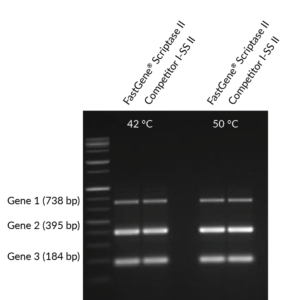
Fig. 1: Comparison of multiplex PCR using cDNA produced by Competitor I‘s SS-II enzyme and FastGene® Scriptase II at 42 °C and 50 °C.
qPCR
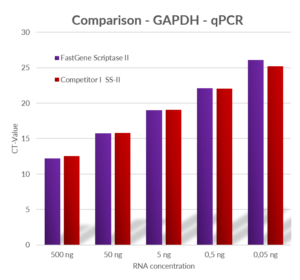
Fig. 2: Comparison of qPCR results using primers for GAPDH and cDNA produced by using different RNA starting concentration by Competitor I‘s SS-II enzyme and FastGene® Scriptase II at 42 °C.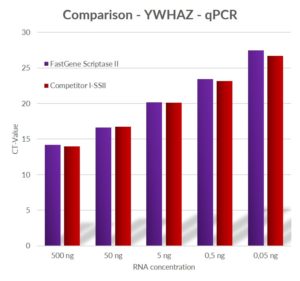
Fig. 3: Comparison of qPCR results using primers for YWHAZ and cDNA produced by using different RNA starting concentration by Competitor I‘s SS-II enzyme and FastGene® Scriptase II at 42 °C.
Dane techniczne
| Opakowanie | 20000 U |